

Methodology & Data Sources
_______________________________________________________________________________________________________________________________
This report analyses data from the Internet Vacancy Index (IVI), and the ABS Labour Force, Detailed (EQ08) series to measure year-on-year (YoY) changes in employment, hours worked, and online job advertisements across 40 Australian health and medical occupations, highlighting emerging and long-term workforce trends by occupation and state.
________________________________________________________________________________________________________________________________
Australian Health Sector Labour Market — Key Highlights, August 2025 data
Record Growth in Health Sector Employment
Australia’s health and medical workforce reached a new high in August 2025, continuing the steady growth recorded over the past decade. The total employed in health and medical occupations rose by around 8 percent over the year, outpacing national labour-market growth.
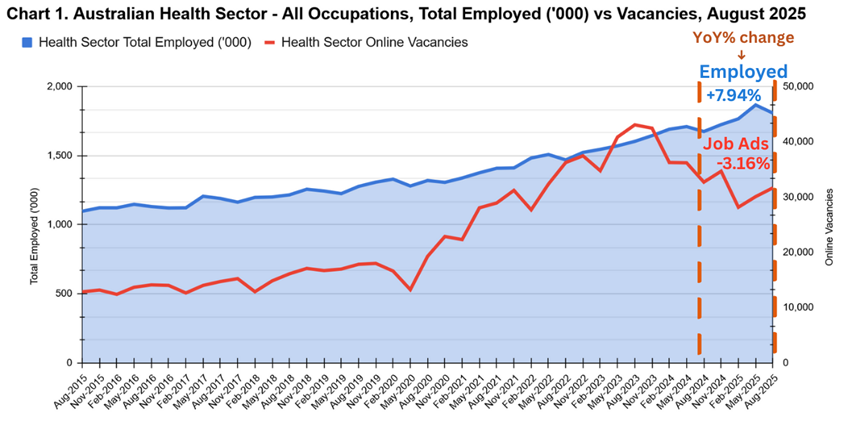
Chart 1 notes: Total Employed data https://www.abs.gov.au/statistics/labour/employment-and-unemployment/labour-force-australia-detailed/latest-release#data-downloads > EQ08 - Employed persons by Occupation unit group of main job (ANZSCO), Sex, State and Territory, August 1986 onwards (Pivot Table), Aug-25 latest data; Job Vacancy data https://www.jobsandskills.gov.au/data/internet-vacancy-index > Data downloads > Internet Vacancies, ANZSCO4 Occupations, States and Territories - August 2025.xlsx. Refer to the ANZSCO Occupation Table below for the x40 health and medical occupations, and occupation groups, covered in this report.
Table 1. Health and Medical Occupations, Total Employed vs Vacancies, AUSTRALIA, August 2025

*Includes occupations in addition to occupation groups, eg. Practice Managers and Health and Welfare Service Managers.
Table 2. Health and Medical Occupations, Total Employed vs Vacancies, by AU State and Territory, August 2025
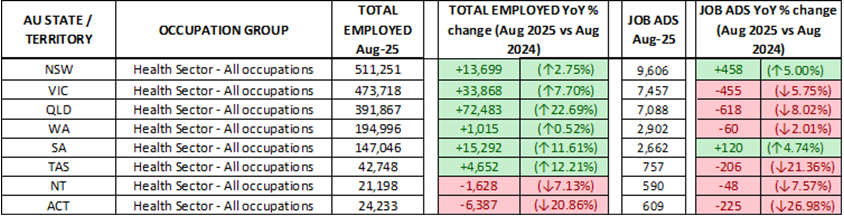
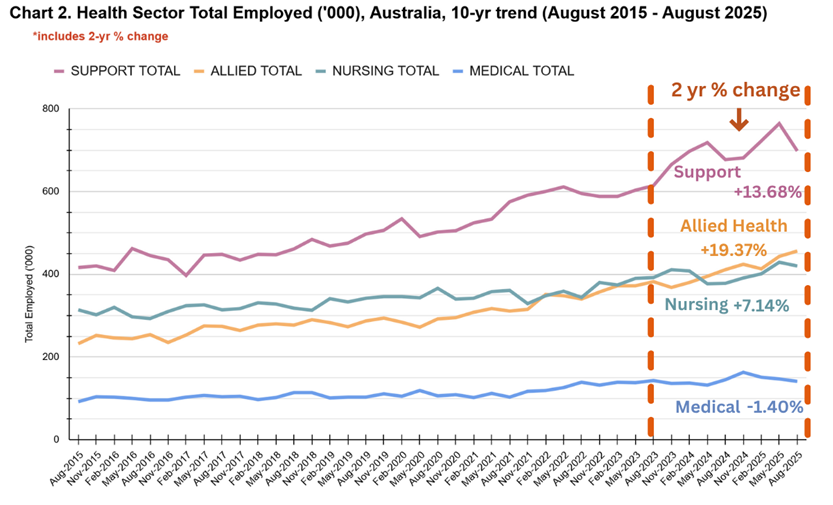
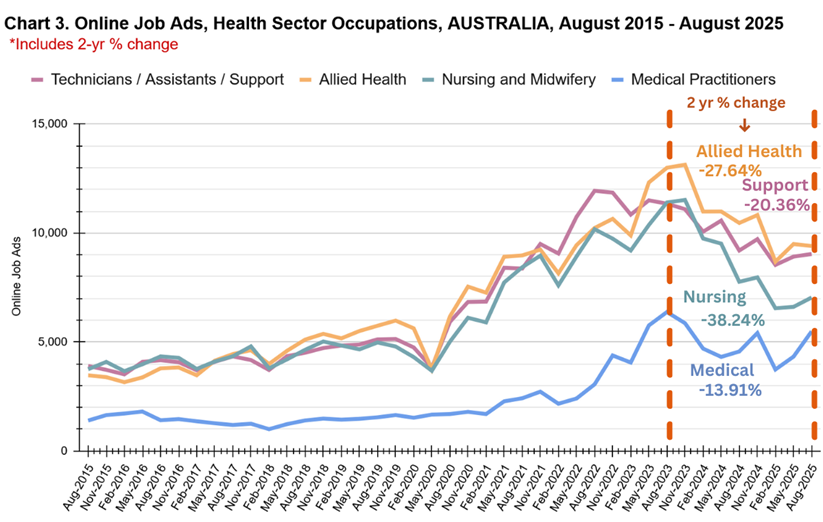
Table 1 &2, Chart 1 & 2. notes: Online Job ads data: https://www.jobsandskills.gov.au/data/internet-vacancy-index > Data downloads > Internet Vacancies, ANZSCO4 Occupations, States and Territories - August 2025.xlsx.Total Employed data: https://www.abs.gov.au/statistics/labour/employment-and-unemployment/labour-force-australia-detailed/latest-release#data-downloads > EQ08 - Employed persons by Occupation unit group of main job (ANZSCO), Sex, State and Territory, August 1986 onwards (Pivot Table), Aug-25 latest data. Refer to the ANZSCO Occupation Table below for the x40 health and medical occupations, and occupation groups, covered in this report.
Major Occupations Drive Growth in Employment Numbers, YoY to August 2025
Nationally, employment gains were strongest among large employing groups, including:
Registered Nurses (+38,000)
Health and Welfare Services Managers (+29,400)
Occupational and Environmental Health Professionals (+14,200)
Nursing Support and Personal Care Workers (+13,800)
Employment in Key Specialist Roles Expanding, YoY to August 2025
Smaller but specialised roles also recorded notable growth in employment numbers:
Nutrition Professionals (↑97.53%)
Indigenous Health Workers (↑64.29%)
Psychiatrists (↑61.67%), Medical Specialists (↑50.89%), and Anaesthetists (↑37.04%)
Nurse Educators and Researchers (↑37.08%), and Nurse Managers (↑32.97%)
Medical Laboratory Scientists (↑33.92%)
Podiatrists (↑42.19%) and Occupational Therapists (↑33.01%)
Workforces Catch Up to Market Demand
Vacancy volumes and vacancy-to-employment ratios eased across much of the sector, reflecting a rebalancing of workforce supply and demand, particularly in management, administrative, and support roles. Allied health employment grew 11.02% nationally, correlating with a 10.11% decline in vacancies over the same period, indicating easing labour market conditions after strong hiring.
Persistent Demand in Clinical Roles and Regional Areas
Demand for Medical Practitioners remains elevated nationwide, particularly for General Practitioners (GPs) and Resident Medical Officers in New South Wales, Queensland, and the ACT. In Tasmania, vacancy rates remain above the national average but show signs of easing. Surgeons continue to record higher vacancy rates in the Northern Territory and Queensland, while demand for Anaesthetists remains strong in Queensland.
Demand pressures are most pronounced in regional and remote areas, notably the Northern Territory, where vacancy rates exceed national averages across multiple occupation groups. This includes sustained demand for clinical support, allied health, and nursing roles, reflecting ongoing workforce shortages outside major metropolitan centres.
Average weekly hours worked per employed person rose slightly in the year to August 2025, up 0.2 hours to 30.2 hours per week across health sector occupations. This modest lift suggests that the workforce remains stable, with employment growth not driven by reductions in average hours or rising underemployment. In other words, new entrants are generally working comparable hours to existing staff. Some allied health and support roles recorded larger increases, reflecting strong demand, while hours in a few administrative and managerial roles were steady or slightly lower, indicating a better alignment between staffing levels and workload.
Table 3. Health and Medical Occupations by Vacancy-to-Employment Ratio, Australia, August 2025
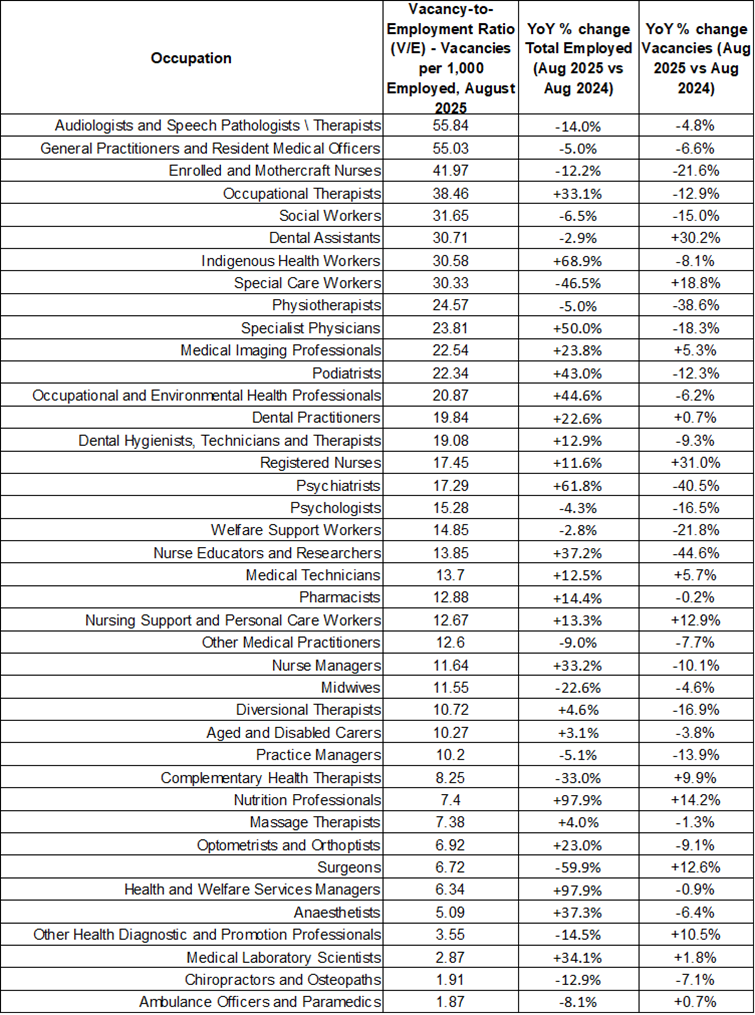
Table 3. notes: This table covers 40 selected health and medical occupations, with year-on-year percentage changes in employment numbers and online vacancies for August 2025. Vacancy-to-employment ratios (vacancies per 1,000 employed) are calculated to highlight relative demand pressures within each occupation.
Key Takeaways
The health labour market remains resilient, supported by strong employment growth in VIC and QLD, helping to ease vacancy pressures.
High-demand medical and clinical fields continue to drive recruitment activity, while management, administrative, and support roles show signs of stabilisation.
Vacancy-to-employment ratios eased overall, suggesting workforce supply is gradually catching up to demand in several categories.
Regional and remote areas remain the focus for workforce planning, where vacancy pressure persists across clinical and allied health roles.
Sustained investment in training and retention will be critical to maintaining workforce balance as demand moderates.


