

The insights and information in this article can be found in Jobs and Skills Australia’s Better Together - The Jobs and Skills Report 2024.
Australia’s overall labour market:
- Labour market conditions less ‘tight’: After robust growth recorded in late 2022 and early 2023, employment growth has eased over the last year and this is expected to put further upward pressure on the unemployment rate, particularly for disadvantaged groups (such as young people, the long-term unemployed, single parents, people with disabilities, or First Nations people).
- Skilled and suitable applicants still in demand: While the average number of applicants per vacancy has been increasing over the last year, employers continue to experience challenges finding suitably skilled workers with only a marginal increase in the average number of suitable applicants per vacancy.
- Overall, less occupations deemed in ‘national shortage’, but shortages remain high for some industries: Overall, the proportion of occupations in national shortage in 2024 is lower than in 2023, but higher for occupations in Mining and Construction, Health Care and Social Assistance, Other Services, and Education and Training.
- More First Nations people employed, but barriers remain: Despite improvement in the proportion and number of First Nations people aged 25-64 who are employed, First Nations workers still accounted for a lower share of higher-skilled occupations.
- Part-time work preferences: Part-time work options help attract workers to occupations in shortage, and allow people flexibility to balance work and life. However, it’s noted that many groups and communities are unable to work the hours they want and need. Women are participating in the labour market at higher rates than ever before, and part-time employment remains more common for female than male workers.
- VET as an enabling pathway, but supply of skilled VET teachers needs attention: VET education is accessible and contributes to a higher chance of employment and annual income for graduates. After their initial qualification, many VET students pursue higher level VET programs or university courses. For industry sectors experiencing skills shortages, VET and TAFE education can be part of a harmonised education system, leading graduates towards higher-skilled professions while they work (eg. the TAFE Queensland enrolled nurse to registered nurse pathway). However, the quality and sustainability of the VET sector is vulnerable to the supply of teachers and trainers, particularly in industry sectors experiencing skills shortages and high employment demand. Ensuring the First Nations VET workforce is grown and supported also remains a priority.
- Future projections: There has been a trend toward service-based industries as well as higher-skilled occupations. 3 major services industries are set to dominate the Australian market, including: Health Care and Social Assistance; Professional, Scientific and Technical Services; and Education and Training – these industries are projected to contribute 50.4% of the projected employment growth in Australia over the next decade. The overall industry structure of the Australian labour market is projected to remain largely unchanged over the next decade, with most industries maintaining their relative shares of total employment.
Australia’s Health Care and Social Assistance industry:
- Largest Employing Industry: The Health Care and Social Assistance is now the largest employing industry in Australia, with the share of total employment projected to increase from 15.7% in 2024 to 17.4% in 2034.
- The economy is shifting toward health, care, education and business services: Health Care and Social Assistance, and Education and Training industries showed shortage pressures of 51% to 72%, in the period since 2022, while Professional, Scientific and Technical Services also had high shortage pressures at 45%.
- Multiple reasons for shortages:
- An ageing population - resulting in an increasing demand for health and support services, while many senior health and medical staff approach retirement
- Technological advances – while alleviating shortages, these can also place extra demand on the existing workforce and resources, while increasing demand for skilled tech staff
- A limited supply of qualified and experienced workers - exacerbated by a long training gap, global demand, and a lower proportion of working-age adults relative to the elderly population over time.
- Limitations in retaining workers and meeting structural employment demands – limited resources and rising costs of living have placed extra pressure on staff and employers, contributing to burnout and fuelling demands for improved working conditions and pay.
- Skilled migration and Australia’s long-term prosperity: While there is a positive link between migration and labour productivity (OECD, 2023), non-targeted migration may not be effective in combating skilled labour shortages. Most temporary migrants enter Australia for non-work purposes but participate in the labour market, while those selected on a skills basis currently make up a small proportion of the temporary migration system. To strengthen the supply of health and medical professionals in Australia, migration settings should promote both temporary and permanent skilled pathways that complement and support the domestic skills and training system.
- Building a harmonised tertiary and training system: Medical colleges, universities, teaching hospitals, VET, and health sector employers, can actively contribute to course and program design, reinforcing a harmonised tertiary system and steady supply of health graduates and training opportunities. There is also a causal relationship between apprenticeship pathways and employment outcomes. The Australian health sector could therefore adopt an apprenticeship scheme similar to NHS apprenticeships.
Australia’s Regions:
- Strong demand for health sector workers continues: Across both metropolitan and regional Australia, occupations in the health care sector are experiencing strong demand and significant shortages remain in regional areas (this is despite other Professional occupations, especially in capital cities, recording easing demand).
- Regional and remote locations still face challenges such as higher unemployment, limited job opportunities, lower education levels, difficulties recruiting suitable workers, lower rates of labour market efficiency, and a higher proportion of older people which places more demand on the health system.
- Job vacancies show long-term growth – online job advertisements in regional Australia over the last decade show a pattern of long-term growth in the provision of healthcare and wider care sector services.
- Online job advertisements for Medical Practitioners and Nurses increased by more than 200% (or 2,700 job advertisements) over the last decade. Large increases were also recorded for Health Diagnostic and Therapy Professionals (up by 218% or 1,600) and for Legal, Social and Welfare Professionals (up by 291% or 2,000).
- The proportion of job ads for Community and Personal Service Workers continues to grow: in regional Australia, almost 15% of all online job advertisements sought Community and Personal Service Workers in August 2024. Over the decade, large increases in job ads were recorded for Carers and Aides (up by 230%, or 3,300 job advertisements), driven mainly by demand for Aged and Disabled Carers and Child Carers, and for Health and Welfare Support Workers (up by 283%, or 940), driven by demand for Welfare Support Workers and Enrolled and Mothercraft Nurses. The strong growth in demand for Community and Personal Service Workers is indicative of demographic changes in regional areas of Australia (ie. aging populations).
- 3 regional areas are experiencing improvement in labour market conditions: In recent years, New South Wales Central West, Geelong and the Sunshine Coast, recorded a notable improvement in current relative labour market conditions.
Future Projections:
- The shift towards services-related industries continues: The structural shift in employment towards services-related industries is projected to continue over the next decade.
- Employment growth will continue for higher skilled roles, but there could be mismatches in labour supply: Employment projections by Victoria University show 90% of employment growth will be for roles that require post-secondary qualifications. However, over the past decade, the trend to 'professionalise" the workforce with higher education attainment may exacerbate future labour market supply and skills shortages, resulting in a surplus of overqualified workers for some roles and a shortage of qualified candidates for others.
- Alternative projections see growth for VET trained occupations: If skill supply, post-secondary training and education responds to market demand, there could be increased employment in occupations with a VET pathway and lower growth in employment for occupations requiring higher education qualifications. In this scenario, employment for all Community and Personal Service occupations, but also for Sales Assistants, General Clerks, Registered Nurses, and Electricians, is projected to grow.
- Age-inclusiveness can reduce shortages: occupations that had a larger proportion of its workforce aged 55 years or older were less likely to have a shortage rating.
Future Projections: Health Care and Social Assistance
The Health Care and Social Assistance industry in Australia is projected to grow by 283,100 persons (or 12.5%) to 2029 and by 585,000 persons (or 25.9%) to 2034. It is projected to be the highest contributing industry to employment growth across all states and territories over the next decade, except for the ACT, where it is the second largest contributor.
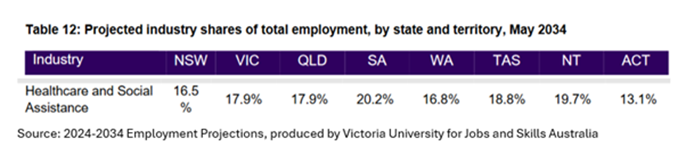
- Strong employment growth is projected in sectors such as Hospitals, Other Social Assistance Services, Allied Health Services, Residential Care Services, and Medical Services.
- Professionals are projected to grow by 409,800 persons or 10.9% to 2029, and by 785,000 persons or 20.9% to 2034 - driven by Health Professionals, including Registered Nurses, General Practitioners, Physiotherapists, and Psychologists.
- Community and Personal Service Workers are projected to grow by 146,000 persons or 8.8% to 2029, and by 294,500 people or 17.7% to 2034. This will be driven by occupations including Aged and Disabled Carers, Nursing Support and Personal Care Workers, Ambulance Officers and Paramedics, and Enrolled and Mothercraft Nurses.
- Managers are projected to grow by 151,500 persons or 8.2% to 2029, and by 291,100 people or 15.7% to 2034. This includes Health and Welfare Service Managers.
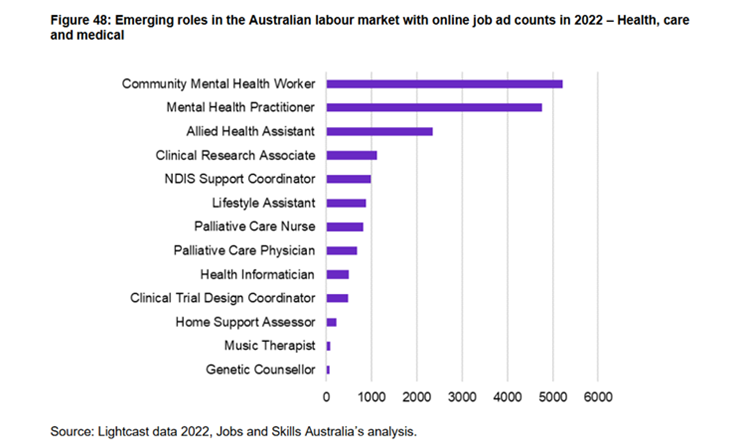
Emerging roles in the Australian Labour Market:
- 37 emerging roles were identified across 4 key themes – Health, Care and Medical; Data and Technologies; Net Zero; and Science and Engineering.
- The largest number of roles were in Health, Care, and Medical, closely followed by Data and Technology.
- Emerging roles in science and engineering, that have cross-overs with the health industry include: molecular biologist and bioinformatician.
Final key points:
- A more harmonised tertiary education and training system will ensure a steady supply of entry workers.
- Flexible options for career-long upskilling and reskilling will also improve supply (see TAFE Queensland enrolled nurse to registered nurse pathway and NHS apprenticeships) and can help transition workers into higher education level study and careers with higher earning potential.
- Adapting to change will take effective coordination across skills, education, migration and employment systems.
- Balancing educational systems to align with labour market needs, is critical for sustainable economic development.


