

The Royal Australasian College of Physicians has published its latest RACP Member Statistics and Insights Report-2023, which provides a detailed snapshot of College membership as of June 2023.
Below we provide a summary of the RACP Member Statistics and Insights Report-2023, including key statistics, trends, and year-on-year comparisons using last year's RACP Member Statistics and Insights Report-2022 (data from June 2022). (**Please note you need to register as a member to access these reports).
RACP member growth rate is positive, but slowing:
Between December 2012 and December 2019, the average annual growth rate was 4.3 percent. However, the latest annual growth rate, from 1 July 2022 to 30 June 2023, was per cent. As a comparison, the annual growth rate from a year earlier (July 2021 to July 2022) was 4.2 percent (the 2022 report is available here for RACP members). This means that the RACP member growth rate is lower than in previous years and that the rate of growth is slowing.
Slightly more RACP members per 100,000 population:
There were 100 RACP members per 100,000 Australian population in July 2023. This is an increase from the previous year (July 2022), which showed 98 RACP members per 100,000 Australian population.
RACP member growth rates > Trainees vs Fellows vs Honorary Fellows:
Growth rates varied between member types. From 2012 to 2022, Fellows saw the strongest growth. The growth rate for Trainees has slowed, and the number of Honorary Fellows has declined.
Chart 1: RACP Member Trend
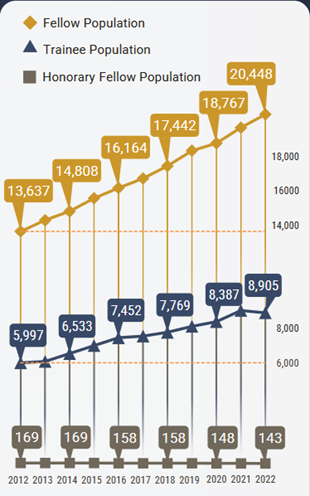
© Royal Australasian College of Physicians, Source: RACP Member Statistics and Insights Report-2023, page 15.
RACP membership numbers by state and country:
In the latest annual period, between July 2022 and July 2023, RACP member numbers grew in all States except NT, with VIC experiencing the highest growth. NT experienced high growth the previous year (July 2021 – July 2022), so this may help explain the negative growth for the latest annual period. Overseas member numbers have made a comeback in the latest annual period, while memberships in ‘Location Unknown’ have reduced.
Table 1:
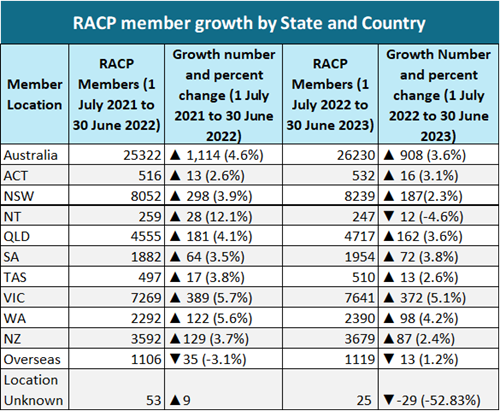
Table 1: Generated by Medicaljobsaustralia.com using data from RACP Member Statistics and Insights Report-2023 and RACP Member Statistics and Insights Report-2022, pg. 4-6
Indigenous RACP members have risen:
The number of RACP Indigenous members has grown since July 2022. There were 72 Aboriginal and Torres Strait Islander members in July 2023, compared to 57 in July 2022.
Retiring Fellows vs Active Fellows remains steady:
The percentage trend has remained steady this year with approximately 92% of Fellows being active, and 8% of Fellows retiring. This is the same as the previous annual period (July 2021 – July 2022).
Active Fellows are averaging less years as specialists:
The July 2023 period saw a slight reduction in the average amount of years that Fellows are active as specialists.
Table 2:
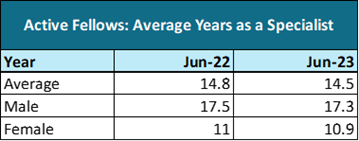
Table 2: Generated by Medicaljobsaustralia.com, using data from RACP Member Statistics and Insights Report-2023, pg. 20, RACP Member Statistics and Insights Report-2022, pg. 20
High numbers of New Fellows in 2022:
The year 2022, followed closely by 2018, saw the highest number of New Fellows. The current growth rate for Female Fellows is over 18 times higher the growth rate for Males Fellows (24 vs 1.3), and the college has admitted more females to membership than males since 2015.
New Fellows are not getting any older:
The average age of New Fellows has fluctuated over time. The graph below tracks the average age of New Fellows since 1989. From 1989 to 2004, the average age of new Fellows increased. However, between 2004 -2005, 2014-2015, and 2016-2017, the average age for New Fellows decreased. The average age of New Fellows in 2015 was 37, while in 2022 it was 36.8 (latest reading from 31 December 2022).
Chart 2:
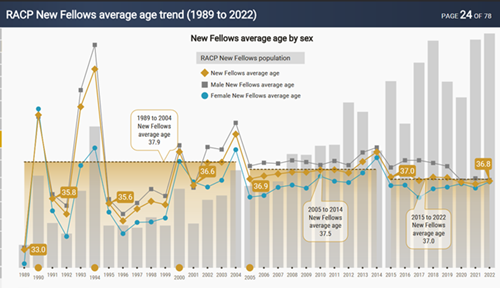
© Royal Australasian College of Physicians, RACP Member Statistics and Insights Report-2023, page 24.
Flat growth for Basic and Advanced Trainees:
Overall, June 2022-June 2023 saw negative annual growth for RACP Trainee numbers, however the decrease was more pronounced in New Zealand. Compared to last year, basic Trainee numbers fell in Australia, while Advanced Trainee numbers were slightly positive. In Australia, declines were for Basic Trainees in the Adult Medicine Division, rather than Paediatrics and Child Health.
Table 2:
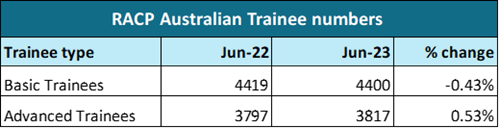
Table 2: Generated by Medicaljobsaustralia.com, using data from RACP Member Statistics and Insights Report-2023 and RACP Member Statistics and Insights Report-2022, pg. 28 (RACP Trainees Overview).
New Trainee population – tracking stable growth since low numbers in 2020:
2022 saw the highest number of New Trainees since 2018 and 2015. The highest growth in the last 8 years occurred in 2015 (rising by 11% from the previous year). In 2022, new trainee numbers decreased for Occupational and Environmental Medicine (AFOEM), Addiction Medicine (AChAM) and Sexual Health Medicine (AChSHM).
Chart 3:
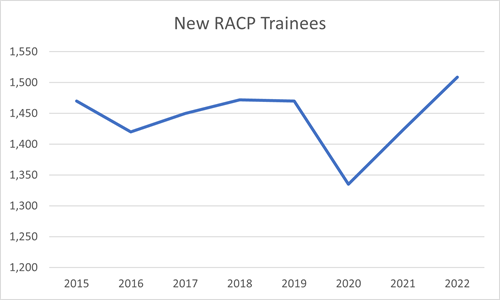
Chart 3: Generated by Medicaljobsaustralia.com, using data from RACP Member Statistics and Insights Report-2023 and RACP Member Statistics and Insights Report-2022, pg. 33 (RACP New Trainees Trends). Yearly numbers are measured on 31 Dec each year.
RACP specialties breakdown: high year-on-year growth for Clinical Haematology
The number of RACP Trainees and Fellows grew across all Specialties, with the highest year-on-year growth observed for Clinical Haematology, at 29.76%. Clinical Immunology and Allergy also saw high growth, however, this was offset by negative growth in Joint Immunology and Allergy (the dual Fellowship stream with RACP and the Royal College of Pathologists of Australasia (RCPA).
Chart 4:
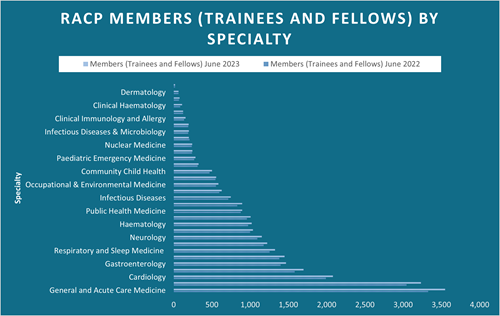
Chart 4: Generated by Medicaljobsaustralia.com, using data from source: RACP Member Statistics and Insights Report-2023 and RACP Member Statistics and Insights Report-2022, pg. 44 (RACP Specialty Population analysis – Fellows and Trainees)
Table 3:
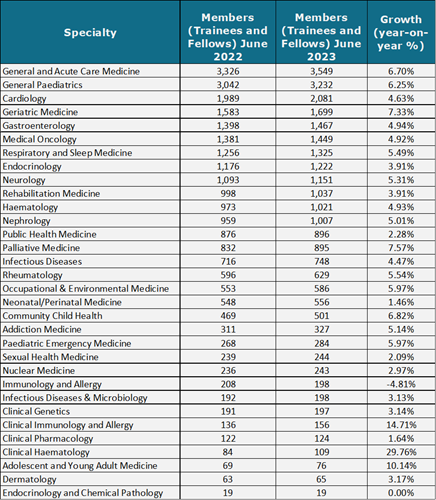
Chart 4: Generated by Medicaljobsaustralia.com, using data from RACP Member Statistics and Insights Report-2023 and RACP Member Statistics and Insights Report-2022, pg. 44 (RACP Specialty Population analysis – Fellows and Trainees)
RACP Divisions, Faculties and Chapters - Palliative Medicine has highest annual member growth
For the last 2 years, between July 2021 and July 2023, the Australasian Chapter of Palliative Medicine (AChPM) was the fastest growing among all Divisions, Faculties and Chapters.
Between July 2022 and July 2023, the Paediatrics & Child Health Division (PCHD) and the Australasian Chapter of Addiction Medicine (AChAM) also experienced a higher rate of growth than the overall College growth rate (3.3 percent).
Table 4:
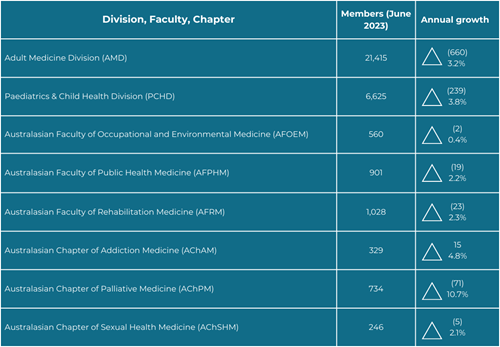
Table 4: Generated by Medicaljobsaustralia.com, using data from source: RACP Member Statistics and Insights Report-2023 and RACP Member Statistics and Insights Report-2022, pg. 49 (Divisions, Faculties and Chapters member overview)
Chart 5: The Pie Chart below shows the distribution of RACP members by Division, Faculty or Chapter, as of 30 June 2023:
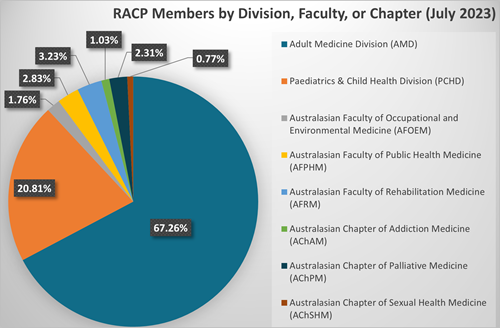
Chart 5: Generated by Medicaljobsaustralia.com, using data from RACP Member Statistics and Insights Report-2023 and RACP Member Statistics and Insights Report-2022, pg. 49 (Divisions, Faculties and Chapters member overview)
Less RACP Training Settings in Australia this year:
There were 368 training settings in Australia in July 2023, a decrease from the 374 training settings in July 2022. Between July 2022 and July 2023, most states saw slight reductions in the number of RACP training settings, however the number of training settings in QLD and NT grew.
Table 5:
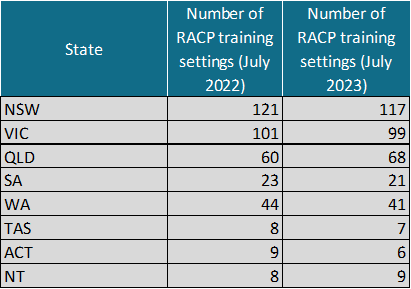
Table 5: Generated by Medicaljobsaustralia.com, using data from RACP Member Statistics and Insights Report-2023 and RACP Member Statistics and Insights Report-2022, pg. 35 (RACP Training settings in Australia)
RACP supervisor-to-trainee ratios have improved and remain steady.
In July 2023, Australia had 5,520 Education Leaders or Supervisors who were supervising at least one trainee with registered rotations. This is an increase compared to the 5,240 in July 2022. In July 2023 there was, on average, one educational leader or supervisor per 2.6 trainees, with VIC supervising a higher ratio of trainees than in other states. In comparison, July 2022 saw one education leader or supervisor supervising 2.7 trainees.


