

Jobs and Skills Australia (JSA) provides Skills Shortage Analysis for occupations in the Australian labour market. They provide an annually updated Skills Priority List (SPL) with occupations in shortage in Australia, and Skills Shortage Drivers (SSD), which help to identify the potential causes of an occupation’s shortage.
Skilled Shortage Drivers (SSD)
The SSD classifies skills shortages into four main categories:
- Long Training Gap
- Short Training Gap
- Suitability Gap
- Retention Gap.
Occupations (ANZSCO 4-digit occupations) on the SPL, and deemed ‘in shortage,’ are put into one of these categories, based on the most likely cause. It should be noted, however, that many occupations will have more than one driver of shortages. The SSD companion paper provides more information on its limitations, topology, methodology, and sources.
Skills Shortages and Skills Shortage Drivers for Australia’s Dental Workforce
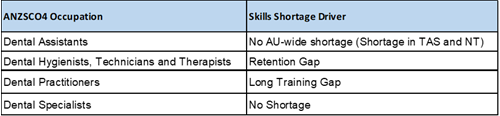
Table notes: Created using JSA’s Skills Priority List > ANZSCO-4 digit occupations (4232, 4112, 2523) and ANZSCO 6-digit occupation (252311).
Australia’s Dental Workforce has mixed Skills Shortage Drivers
General Dental Practitioners are in short supply in Australia, with growing workforce numbers impacted by a long training gap. Long Training Gap shortages are characterised by few qualified applicants per vacancy and a long training pathway to acquire the necessary qualifications, skills and registration to practice. Shortages of this nature are particularly challenging because increasing the number of skilled workers must account for the significant time lags inherent in the training process.
In comparison, Australia’s shortage of Dental Hygienists, Dental Prosthetists, Dental Technicians and Dental Therapists is characterised by a retention gap. Retention Gap shortages occur when retention rates are below average, and this may be compounded be having too few new applicants to fill vacancies. Simply increasing the number of qualified applicants won’t solve this issue due to low retention likelihood, and instead, improving the occupation's appeal through better pay, enhanced working conditions, professional development, and clearer career pathways are potential solutions to mitigate such shortages.
While Dental Assistants are not in national shortage, Tasmania and the Northern Territory face a short supply. These state-wide shortages are likely linked to rural and remote workforce challenges.
There is no shortage of Specialist Dentists in Australia. In Australia, General Dentists undertake at least 5 years of study, while Specialist Dentists undertake a further 2-8 years of specialist training, depending on the speciality. Dental Specialities include: Dento-maxillofacial radiology, Endodontics, Forensic odontology, Oral and maxillofacial pathology, Oral and maxillofacial surgery, Oral medicine, Oral surgery, Orthodontics, Paediatric dentistry, Periodontics, Prosthodontics, Public health dentistry (Community dentistry), and Special needs dentistry.
Rural and remote workforce challenges continue: Building local workforce capacity, including the training, recruitment and retention of dental practitioners in rural and remote Australian locations, is challenged by many factors. A lack of rural dental and oral health clinical schools, including insufficient resourcing of student supervision and other academic supports, hinders the development of a ‘home-grown’ workforce. Dental professionals may be discouraged from moving to rural and remote areas due to distance and travel constraints, limited school options for their family members, and a lack of commercial incentives for private practice (or limited availability of public clinic dentistry posts).
The table below, reprinted from the National Rural Health Alliance Factsheet on Oral and Dental Health in Rural Australia, shows the prevalence (in 2021) of full-time equivalent (FTE) AHPRA registered dental professionals per 100,000 population, by Australian location (Modified Monash Model classification). Dentists are much less prevalent in MMM5-7 locations, or rural and remote locations.
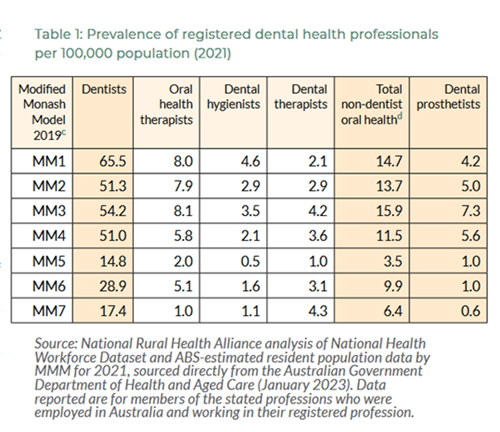
Table source: reprinted from https://www.ruralhealth.org.au/sites/default/files/publications/nrha-oral-health-fact-sheet-2023.pdf
Dental Practitioners in Australia, Facts and Stats (2023/24):

Table notes: reprinted statistics from https://www.jobsandskills.gov.au/data/labour-market-insights/occupations/2523-dental-practitioners
Overseas-trained Dental Practitioners (2022):
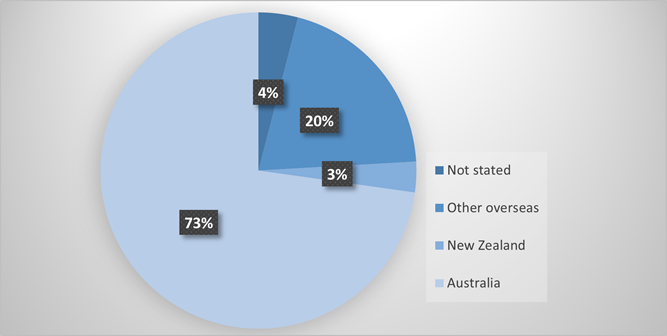

Chart and Table notes: generated using the Health Workforce Data Tool > Professions by Initial Country of Qualifications and Year (2022) by Workforce Status (Filters: Workforce Status : Employed in Australia working in registered profession, Default Summation : Number of Practitioners).
AHPRA Dental Practitioner Registrations 2022/23, first-time registrants:
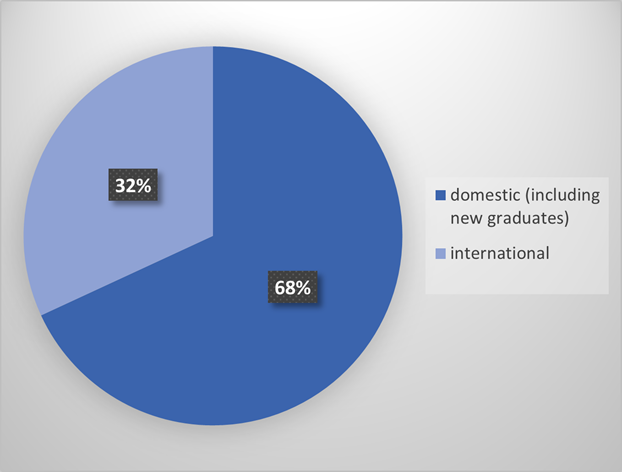
Chart notes: created using statistics from the Dental Board of Australia (AHPRA) Annual Report> Dental Practice in 2022/2023 > Registration> 1,505 first-time registrants, 1,025 domestic (including new graduates), 480 international.
Job settings, public vs private, 2022:
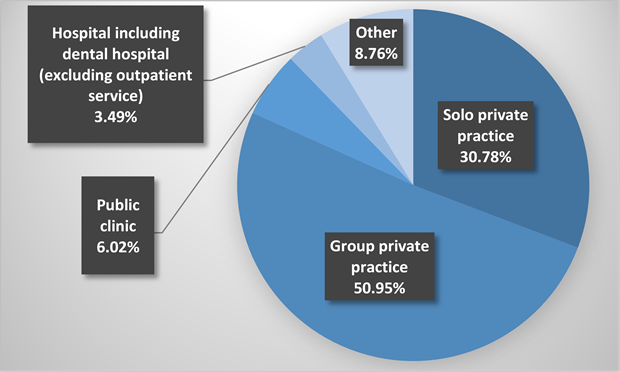
Chart generated using the Health Workforce Data Tool > Professions (Dental Practitioners) and Job Setting by Year (2022) by Workforce Status (Filters: Workforce Status: Employed in Australia working in registered profession) > Default Summation: Number of Practitioners, percentages.*Other- combines multiple job settings with <3% Practitioner workforce.


