Australia's Healthcare and Social Assistance Industry: Summary of Employment Growth, Sector Distribution, and Largest Employing Occupations

March 22, 2024

Share Now

Our summary utilises Labour Market Insights (Healthcare and Social Assistance Industry), on the Australian Government’s Jobs and Skills Australia platform.

The number of workers in the Health Care and Social Assistance Industry grew by 6.1% over the last year (Nov-22 vs Nov-23), compared to an average of 2.2% across all industries in Australia. Figure 1 below shows long term quarterly employment growth for the Healthcare and Social Assistance Industry, from 2004 – 2024.

Figure 1:
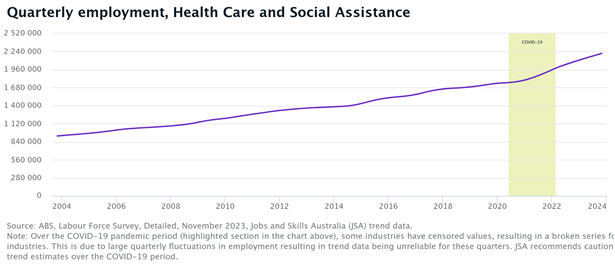
Figure 1. Reprinted from Jobs and Skills Australia – Labour Market Insights, Healthcare and Social Assistance>Employment, retrieved on 20/03/24.

Hospitals remain the largest employing sector of the Healthcare and Social Assistance industry in Australia. Figure 2 below shows hospitals employ 29% of the Healthcare and Social Assistance workforce, followed by Other Social Assistance Services which employ 27%.

Figure 2: Australian Health Care and Social Assistance Industry, Employment Distribution by Health Service Type (Sector).
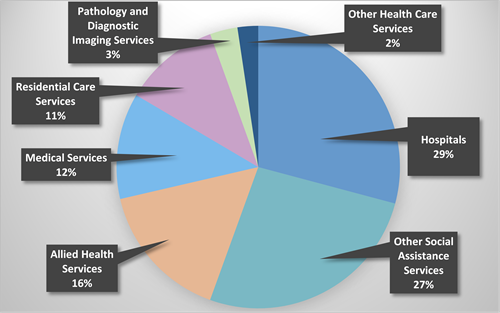
Figure 2. Generated by MedicalJobsAustralia.com using data from Jobs and Skills Australia, Labour Market Insights, Healthcare and Social Assistance Industry > Sectors (Original Source: ABS Labour Force Survey, detailed, Nov-23, Jobs and Skills Australia Trend Data). *To note: the sum of the pie chart does not equal the industry total, eg. Child Care Services and “not further defined” classifications have been excluded.

The health sector occupations with the largest employment numbers include Registered Nurses, Aged and Disabled Carers, Nursing Support and Personal Care Workers, General Practitioners and Resident Medical Officers, Welfare Support Workers, Physiotherapists and Psychologists.

News articles linked via MedicalJobsAustralia.com are the copyright of the respective media organisations providing them.

Analysis and commentary © 2025 Health and Medical Pty Ltd.

Related Articles

Employee earnings and hours in the health care and social assistance industry: ABS data trends from May 2016 – May 2023

Our analysis looks at the latest ABS data that estimates employee earnings and hours, pay settings, and public vs private sector wages and distribution – available by industry and occupation category.

Read More
Growth in GP Training Numbers in Communities with Health Workforce Shortages Shows Incentives Work

The Royal Australia College of GPs (RACGP) urges the Government to fund more incentives and subsidised training to bolster GP numbers in community areas of need. Current incentives have proven effective, filling 114 training positions in areas of workforce shortage, many of which lacked registrars for extended periods. Newly filled GP training spots rose to 91% in 2024 from 85% in 2023, with an 11% increase in rural placements.

Read More
Have your say - Proposed Guidelines for Privately Practising Nurses – NMBA Consultation

The Nursing and Midwifery Board (NMBA) is seeking feedback and public consultation on the proposed guidelines for privately practising nurses (PPNs). This impacts enrolled nurses and registered nurses working privately outside of a health service setting. The NMBA provide an online survey and a detailed consultation paper for reference. Feedback is required by Friday 12 April 2024.

Read More
The AMC Guidance Matrix for Medical School Standards

The Australian Medical Council (AMC) has released its Guidance Matrix which accompanies the 2023 Standards for Assessment and Accreditation of Primary Medical Programs (medical school standards). The document communicates AMC accreditation expectations for stakeholders, such as medical schools, assessment teams and reviewers. It includes ‘explanations’ of standards in plain English, examples of acceptable evidence, and expert resources. AMC also provides a User Guide and feedback form.

Read More
All Blog Articles